Trial by Fire: Forging American Close Air Support Doctrine, World War I through September 1944 by Major Philip W. Wielhouwer
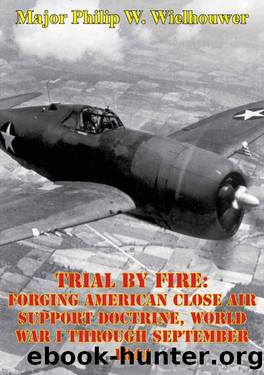
Author:Major Philip W. Wielhouwer [Wielhouwer, Major Philip W.]
Language: eng
Format: epub
Publisher: Pickle Partners Publishing
Published: 2014-04-20T21:00:00+00:00
CHAPTER 4 — PERFECTING THE SYSTEM: JULY 1943 TO SEPTEMBER 1944
The release of FM 100-20 created substantial turmoil at AAF doctrine centers in Washington, D.C. and Maxwell Field, Alabama, while impacting combat operations to a lesser degree. Combat experience now drove official doctrine, not the other way around. Functional areas at AAF HQ took the secondary role of attempting to capture usable combat lessons. Characterized by bold tactical innovation, air operations in Sicily, Italy, and France continued its metamorphosis, using FM 100-20 as a guide, but not hesitating to make adjustments based on the tactical or operational situation. While missteps occurred, American air forces adapted, fine-tuning liaison and the TACS functions, while organization, command, and airpower roles stabilized.
FM 100-20’s functional divisions--strategic, tactical, air defense, and air service-rendered the AAF School of Applied Tactics departments obsolete. In an 8 October 1943 reorganization the AAF Tactical Center was created to administer the AAF School of Applied Tactics and run a demonstration air force equipped with model strategic and tactical air forces and a model air defense wing.[150] On the same date, the AAF Board folded into HQ AAF, empowered to “develop tactics, techniques, and doctrines and to determine all military requirements for the Army Air Forces.”[151] Despite a roster of over 200 personnel, the board’s ability to produce doctrinal publications remained limited. Combat proven procedures would not be published until mid-1945 in preparation for an expected invasion of Japan.
Competition and mistrust between the US AGF and the AAF continued to delay doctrine publication. In April 1944, the AGF HQ refused to approve a draft TC entitled “Air-Ground Cooperation,” citing overlap with FM 100-20 and employment impracticality. The AGF also resisted signing off on an AAF Board submission entitled “Tactical Air Force: Organization and Employment.” These two documents, considered essential by the AAF to replace the obsolete FM 31-35, were not released until the WD included enough compromises to publish them as TC No. 17, Air-Ground Liaison, on 19 April 1945, and TC No. 30, Tactical Air Command: Organization and Employment, on 19 June 1945. The interim voids left by the obsolete FM 31-35 and the controversial FM 100-20 (which was strong on organization, but weak on operations), left theater combat forces to develop their own air-ground cooperation techniques.[152]
Fortunately, Allied forces were proactive in making changes they thought necessary to accomplish the mission; in fact, the WD had a standing policy of soliciting suggestions for doctrine changes in organization and tactics.[153] On 10 March 1944, Lieutenant General Mark W. Clark, commander, US Fifth Army, in coordination with Brigadier General Gordon P. Saville, commander, Twelfth ASC, recommended an air operations position (G3-Air) be added to all corps and divisions, and organic army signal companies be reorganized to provide air-ground liaison communication capabilities the air force squadrons had been providing. The WD implanted this non-doctrinal, combat driven recommendation nearly verbatim into TC 17 and official doctrine.[154]
Tactical doctrine during this period changed in much the same way, but rather than being published, it passed from pilot to pilot, unit by unit.
Download
This site does not store any files on its server. We only index and link to content provided by other sites. Please contact the content providers to delete copyright contents if any and email us, we'll remove relevant links or contents immediately.
| Africa | Americas |
| Arctic & Antarctica | Asia |
| Australia & Oceania | Europe |
| Middle East | Russia |
| United States | World |
| Ancient Civilizations | Military |
| Historical Study & Educational Resources |
Room 212 by Kate Stewart(5189)
The Crown by Robert Lacey(4870)
Endurance: Shackleton's Incredible Voyage by Alfred Lansing(4849)
The Iron Duke by The Iron Duke(4411)
The Rape of Nanking by Iris Chang(4269)
Joan of Arc by Mary Gordon(4160)
Say Nothing by Patrick Radden Keefe(4050)
Killing England by Bill O'Reilly(4046)
I'll Give You the Sun by Jandy Nelson(3499)
Shadow of Night by Deborah Harkness(3412)
Hitler's Monsters by Eric Kurlander(3389)
Blood and Sand by Alex Von Tunzelmann(3246)
Mary, Queen of Scots, and the Murder of Lord Darnley by Alison Weir(3243)
Eleanor & Park by Rainbow Rowell(3241)
Darkest Hour by Anthony McCarten(3165)
Margaret Thatcher: The Autobiography by Thatcher Margaret(3115)
Book of Life by Deborah Harkness(2988)
Red Famine: Stalin's War on Ukraine by Anne Applebaum(2973)
The One Memory of Flora Banks by Emily Barr(2902)
